How to use the series and parallel resistor calculator
- Choose Series (resistors end to end) or Parallel (resistors side by side, sharing the same two points).
- Type each resistor value and pick Ω, kΩ or MΩ. Use + Add resistor for up to 8; empty boxes are ignored.
- Optionally enter the supply voltage. The table then shows the voltage, current and power for every resistor, and warns you if a ¼ W resistor would overheat.
- Need a value you don't have? Switch to Find missing R, enter the target total and the resistor you already have, and get the second resistor plus the nearest standard E12, E24 or E96 value.
Formula
In series, the same current flows through every resistor, and the supply voltage divides in proportion to the resistances. In parallel, every resistor has the same voltage across it, and the current divides — the smallest resistor takes the most.
| Series | Parallel | |
|---|---|---|
| Total resistance | Bigger than the largest | Smaller than the smallest |
| Current | Same in every resistor | Splits — most through the smallest |
| Voltage | Splits — most across the largest | Same across every resistor |
| One resistor breaks open | Everything stops | Other branches keep working |
Making a value you don't have
Standard resistors come in fixed series (E12: 10, 12, 15, 18, 22, 27, 33, 39, 47, 56, 68, 82 and their multiples). To get an in-between value, combine two:
- Series for a bigger value: 1 kΩ + 500 Ω = 1.5 kΩ.
- Parallel for a smaller value: you need 600 Ω and have 1 kΩ, so Rx = (600 × 1,000) ÷ (1,000 − 600) = 1.5 kΩ. Check: 1 kΩ ∥ 1.5 kΩ = 1,500,000 ÷ 2,500 = 600 Ω.
If the exact answer is not a standard value, the calculator lists the standard values on either side and how far off the total will be. For example, 3.3 kΩ from a 4.7 kΩ needs 11.08 kΩ; the nearest E12 part is 12 kΩ, giving 3.377 kΩ (+2.3%).
Common mistakes
- Adding parallel resistors like series ones. Two 10 kΩ in parallel is 5 kΩ, not 20 kΩ. If your parallel total is bigger than the smallest resistor, something is wrong.
- Forgetting the units. Mixing 4.7 (kΩ) with 470 (Ω) is the most common error — set each unit drop-down carefully.
- Ignoring power. The total may be right but one resistor can still overheat. Enter the supply voltage and check the power column.
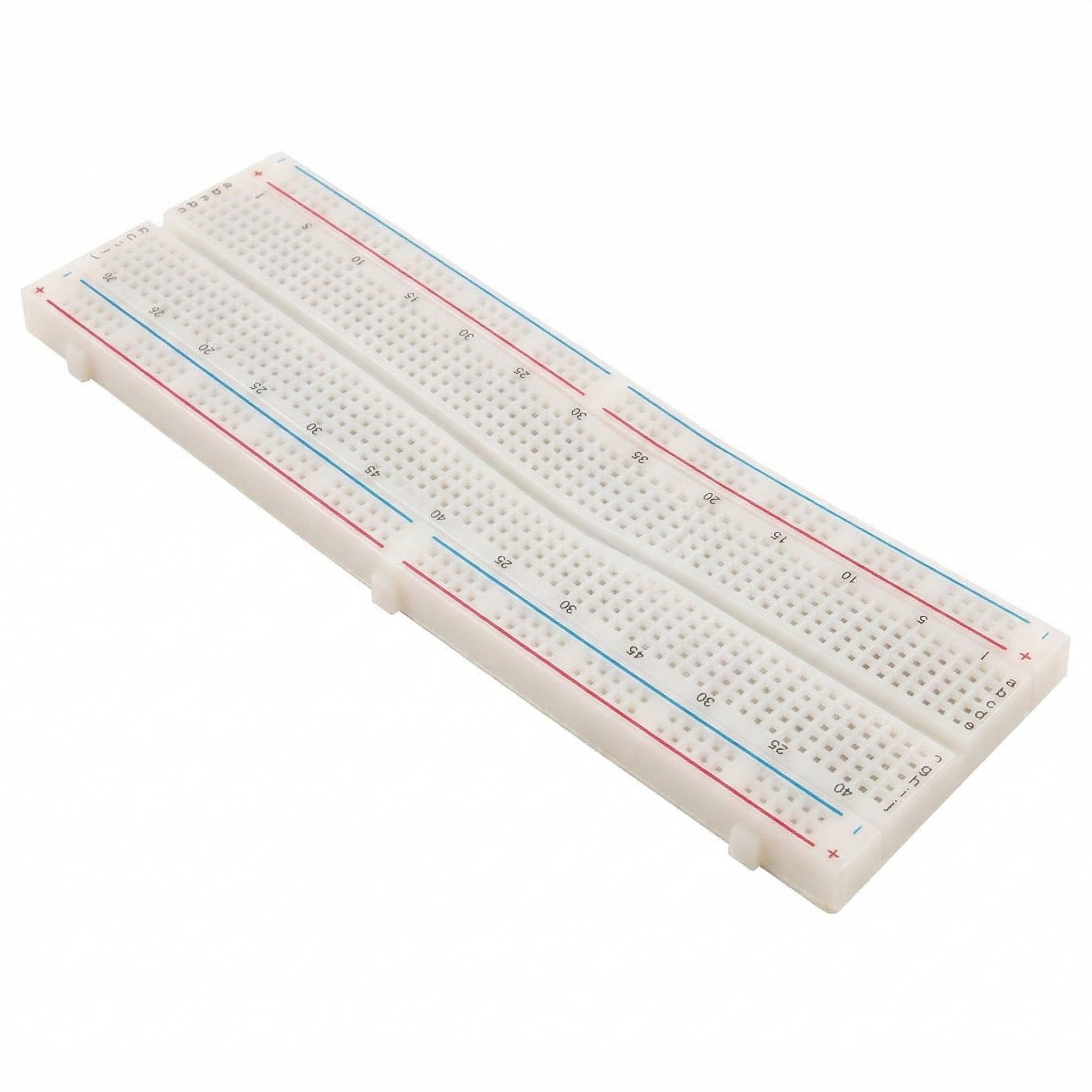
- Thinking breadboard rows are in parallel. Two resistors in the same 5-hole row share one end; check both ends before deciding how they are connected. Our breadboard basics guide explains how the rows are linked.
Related tools
Work out a single resistor's current and power with the Ohm's law calculator, read resistor values with the resistor colour code calculator or the SMD resistor code calculator, and build a two-resistor divider with the voltage divider calculator. For the theory, read Ohm's law explained with examples.