⚡Ohm's Law Explained: Voltage, Current and Resistance with Real Examples
Understand voltage, current and resistance with a simple water analogy, worked examples from real Arduino and LED circuits, and the mistakes beginners make most often.

In this article (14)
- The three quantities
- The formula and the Ohm's law triangle
- Example 1: current through a resistor
- Example 2: choosing an LED resistor for an Arduino
- Example 3: how much current does a sensor draw?
- Power: the part beginners forget
- Ohm's law on a graph
- Common mistakes to avoid
- Try it yourself
- Frequently asked questions
- What is Ohm's law in simple words?
- Who discovered Ohm's law?
- Does Ohm's law apply to AC circuits?
- Why is my measured current different from my calculation?
Every circuit you will ever build — a blinking LED, a line-following robot, an ESP32 weather station — obeys one simple rule. It is called Ohm's law, and once it clicks, a lot of electronics suddenly makes sense.
This guide explains it without heavy maths, using a water analogy, real circuits and worked examples you can check with our free Ohm's law calculator.
The three quantities
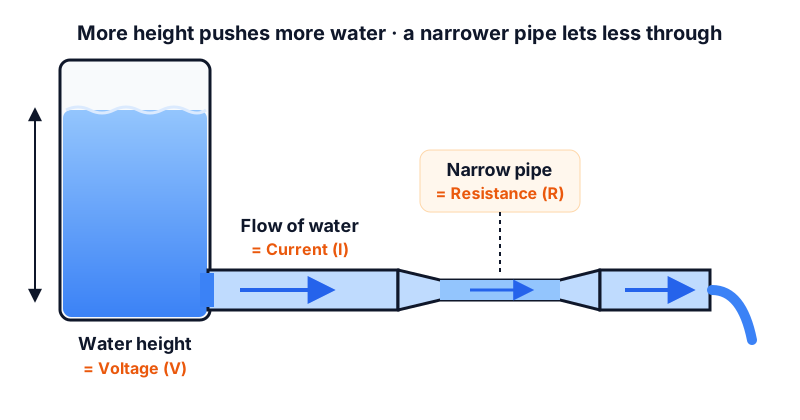 The water analogy: pressure ≈ voltage, flow ≈ current, a narrow pipe ≈ resistance
Imagine water flowing from a tank through a pipe:
| Electricity | Symbol | Unit | Water analogy |
|---|---|---|---|
| Voltage | V | volt (V) | Water pressure from the height of the tank |
| Current | I | ampere (A) | How much water flows per second |
| Resistance | R | ohm (Ω) | How narrow the pipe is |
| Power | P | watt (W) | How much work the flowing water can do |
A taller tank (more voltage) pushes more water. A narrower pipe (more resistance) lets less through. That is exactly what Ohm's law describes.
The formula and the Ohm's law triangle
Rearranged, this gives the two other forms:
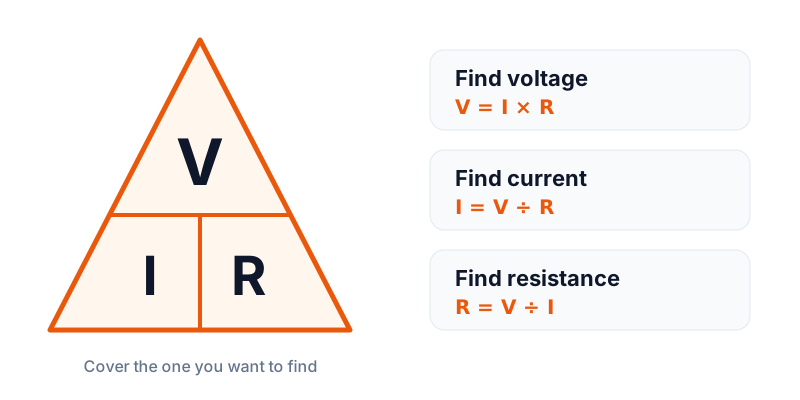 Cover the value you want: V = I × R, I = V ÷ R, R = V ÷ I
A handy trick is the triangle: put V on top, and I and R side by side underneath. Cover the value you want with your finger. What is left shows how to calculate it — side by side means multiply, one above the other means divide.
Example 1: current through a resistor
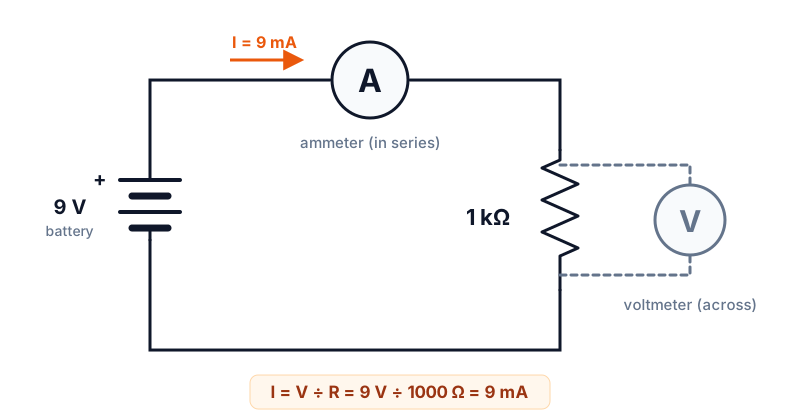 A 9 V battery across a 1 kΩ resistor. The ammeter reads the current.
A 9 V battery is connected across a 1 kΩ (1,000 Ω) resistor. How much current flows?
Example 2: choosing an LED resistor for an Arduino
An Arduino Uno pin gives 5 V. A red LED needs about 2 V across it and is happy at 15 mA. The resistor must take the remaining 3 V:
This is the most common Ohm's law calculation in hobby electronics. Our LED resistor calculator does it for any LED colour, supply and number of LEDs, and even shows the resistor colour bands.
Example 3: how much current does a sensor draw?
You measure 3.3 V across a sensor module and the datasheet says it behaves like 660 Ω when active. I = 3.3 ÷ 660 = 5 mA. On a 2,000 mAh battery that is roughly 400 hours if nothing else is running — a quick way to estimate battery life.
Power: the part beginners forget
Current flowing through a resistance makes heat. The power is:
| Resistor size (through-hole) | Common rating | Safe continuous power (2× margin) |
|---|---|---|
| Small, in most kits | ¼ W | up to about 0.12 W |
| Medium | ½ W | up to about 0.25 W |
| Large | 1 W | up to about 0.5 W |
| Power resistor | 2 W – 10 W | follow the datasheet |
Ohm's law on a graph
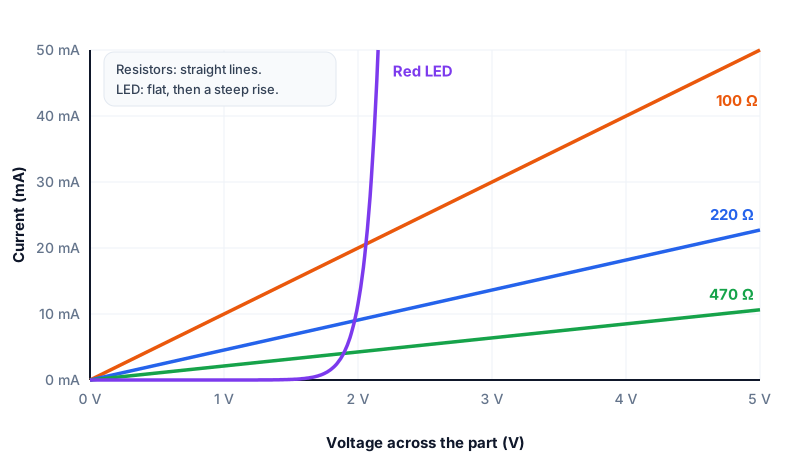 Resistors give straight lines; an LED's current shoots up after its forward voltage
If you plot current against voltage for a resistor you get a straight line — doubling the voltage doubles the current. The bigger the resistance, the flatter the line.
An LED is different. Almost no current flows until about 2 V, then the current shoots up. That is why you can't use Ohm's law on the LED itself, and why an LED always needs a series resistor.
Common mistakes to avoid
- Mixing units. Convert mA to A (divide by 1,000) and kΩ to Ω (multiply by 1,000) before calculating, or use a calculator with units.
- Using the supply voltage instead of the voltage across the part. In the LED example, the resistor only sees 3 V, not 5 V.
- Applying Ohm's law to non-linear parts. LEDs, diodes, motors and batteries do not follow a straight line.
- Ignoring tolerance. A 5% resistor marked 220 Ω can be anywhere from 209 Ω to 231 Ω. Real measurements will differ slightly from your calculations.
Try it yourself
Grab a multimeter, a 9 V battery and a few resistors from any Thinking Robot kit. Measure the voltage across a resistor, calculate the current with Ohm's law, then switch the meter to current mode and check. Seeing the numbers match is the best way to make the formula stick.
Ready for something that moves? Use what you learned here to power motors safely in our robot car motor driver guide, or try the 5 hands-on electronics experiments for kids.
Frequently asked questions
What is Ohm's law in simple words?
Ohm's law says the current through a resistor is the voltage across it divided by its resistance. More voltage means more current; more resistance means less current.
Who discovered Ohm's law?
The German physicist Georg Simon Ohm published it in 1827 after experiments with wires of different lengths and thicknesses.
Does Ohm's law apply to AC circuits?
Yes for resistors, using RMS values. For capacitors and inductors you use impedance instead of resistance, but the idea V = I × Z is the same.
Why is my measured current different from my calculation?
Resistor tolerance, the battery's internal resistance and a voltage that drops under load all cause small differences. A difference of a few percent is normal.
Try the calculators
Ohm's Law Calculator
Enter any two of voltage, current, resistance or power and get the other two instantly, with units and the right resistor wattage.
LED Resistor Calculator
Find the right series resistor for any LED or LED string, with the nearest standard value, colour code and power rating.
555 Timer Calculator
Calculate frequency, period, high/low time and duty cycle of a 555 astable, or the pulse width of a monostable, with a live waveform.
Series and Parallel Resistor Calculator
Add up to 8 resistors in series or parallel, see how voltage and current split, and find the missing resistor for a target value.
Thinking Robot Team
Thinking Robot is a team of engineers and educators in Pune who design electronics and robotics kits and run hands-on workshops for students and schools. Spotted a mistake or have a question? Get in touch.